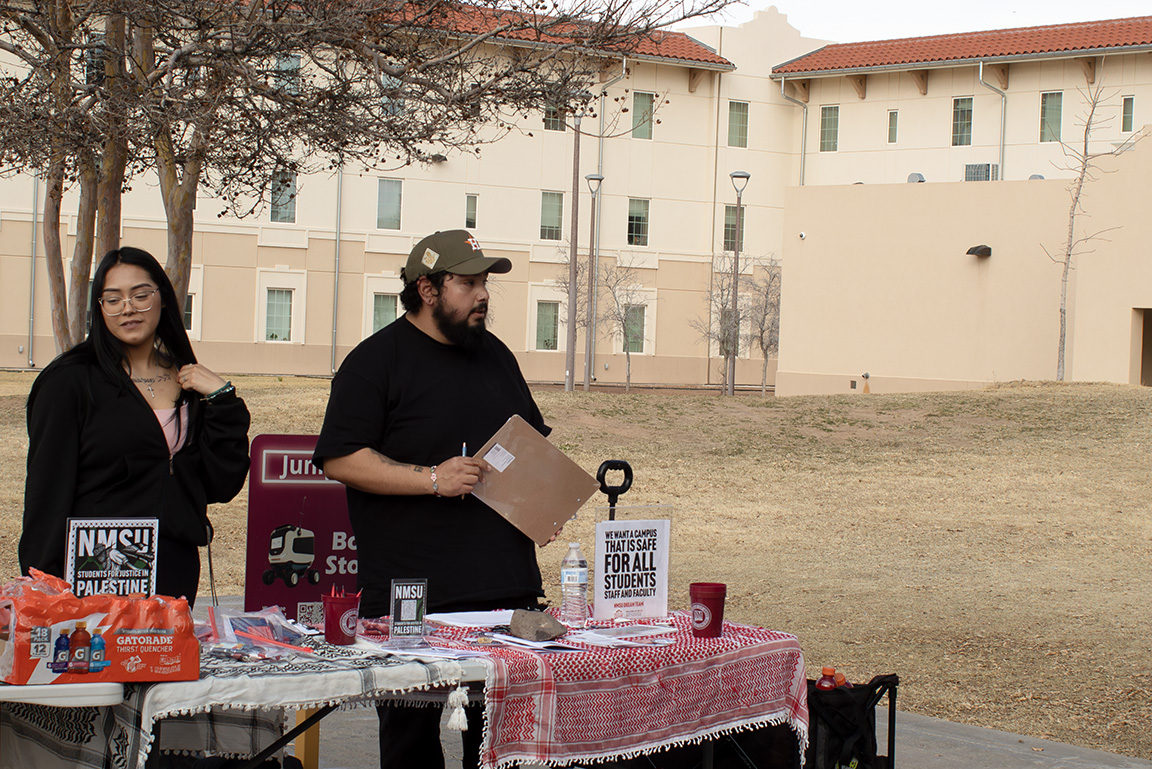
The Students for Justice in Palestine (SJP) at New Mexico State University hosted a film screening of “The Time That Remains” on Nov. 2 at Preciado Park, bringing a crowd of students and community members together for an evening of reflection on Palestinian history and their ongoing struggles for justice.
The event ran from 6 to 8:30 p.m. and featured the semi-autobiographical film directed by Elia Suleiman. The movie follows a family through generations, starting in the 1940s, throughout the establishment of Israel and the Israeli-Palestinian conflict and into the present day. Blending a personal narrative and a broader historical setting, the film serves as a window into the lived experiences of Palestinians navigating life in the midst of armed conflict and violent discrimination.
The screening was catered by Yala Falafel, a local restaurant, providing attendees with authentic Middle Eastern cuisine as a part of the cultural experience. The food offered was not only sustenance but also a tangible connection to Palestinian and broader Arab culture, allowing attendees to engage with the region through multiple senses.
Before the screening began, a couple of speakers took the opportunity to address attendees about the significance of standing in solidarity of the Palestinian people, the importance of awareness, and the ongoing nature of the conflict. Their remarks set the tone for the evening, encouraging attendees to engage with the content of the movie and consider their own role in supporting justice.
Kademan Ragland, President of the Graduate Workers Union, emphasized the long-standing struggle faced by Palestinians and underscored how the conflict has persisted for decades and affected countless lives.
“We’ve seen atrocities larger than words can describe. This is an injustice that has been going on since before my mother was born,” Ragland said.
He spoke about the suffering Palestinian people have faced at the hands of Israel and expressed hope that the current generation would be the one to witness Palestinian liberation. His message acknowledged historical pain with optimism for future change, urging attendees to maintain their commitment to the cause.
Additionally, Menaul Hanza provided important context for the film selection, noting that it was “the third in a series of films that are both humorous and also disturbing at the same time, about the injustice in Palestine.” That description highlighted the necessity of humor in the midst of traumatic situations, but she also emphasized the necessity to think deeply and reflect upon the tragedy.
“While humor is important in times like these, it is also equally as important to consider what it all means. To think deeper than it being ‘just another film.’ So I encourage you all to open your minds and hearts, be curious, and think about it,” Hanza said.
Alberto Del Campo, vice president of Students for Justice in Palestine, called for emotional engagement with the Israeli-Palestinian conflict that extends beyond a single event or a moment of solidarity.
“We must have Palestine in our hearts and let Palestine affect us in our everyday lives,” Del Campo said.
He emphasized that supporting Palestinian rights requires ongoing commitment and cannot be limited to occasional demonstrations of solidarity.
The event ended with an invitation to SJP’s next event scheduled for Nov. 13 from 5 to 7:30 p.m. This upcoming event will feature “an eyewitness in Palestine, a report back from the West Bank,” offering its attendees a firsthand account of current conditions in the occupied territories.

The club’s president, Jonah Holguin, extended an invitation to the broader Las Cruces community to attend future club meetings and events. He encouraged everyone, students and non-students alike, to join the SJP and stand in solidarity regardless of whether they can attend the regular meetings or not.
“We encourage everybody, students and non-students alike, to join us,” Holguin said.