NMSU’s American Indian Program (AIP) hosted Sapphira Garner, creator of “Haffbreedz Podcast,” to share how podcasting supports and sustains Native American knowledge and experiences through resistance.
Garner started her podcast “Haffbreedz” in 2023 as a way to talk about how she and her husband, Gabe Garner, navigate their multi-racial identities. She dives deep into the struggles of being Diné in a post-colonial society.
“We initially started to talk about the dichotomy of being Indigenous and being the other,” Garner said. “So our white side…we talk about living in that world, where we’re not considered white, we’re considered something else based on aesthetics…but how we identify is all about who our mothers are, and our mothers are Diné, so we claim Indigenous identity.”
Garner’s thesis, “Mic’d & Marginalized: Indigenous Storytelling, Ceremony, Resurgence, and Continuance through Podcasting” goes further into how she navigates sharing stories and information while avoiding colonialist terms. She explained that research is a “a harmful word for Indigenous communities because of its history of taking rather than relating,” and what that encompasses.
“It’s important to recognize where western research comes from…that’s what we’re taught,” Garner said. “…They rely on data collection, analysis, findings, conclusions, assuming that knowledge can be taken from people and owned by the researcher. These frameworks developed during the colonial era built on systems of classification and control, so the goal of the research is not about relationships. Instead, it’s about management to observe and categorize and make sense of the other or marginalized groups.”
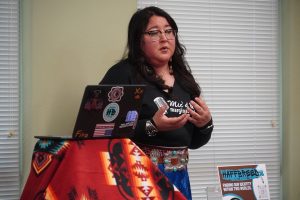
Garner says this is why she chooses to use different wording when telling stories.
“Instead of using words like data, data analysis, data collection, findings, conclusion, I use other words,” Garner said. “Instead of research, I say story work. I use terms like survivance and resurgence, presence instead of findings, continuance instead of conclusion.”
Garner included the struggles Indigenous peoples go through when trying to share their stories, including microaggressions, invisibility, isolation, or exclusion, and how she pushes through it.
“When I first started this work, I believed that my focus would be on institutional harm,” Garner said. “…but instead of seeing that harm as an endpoint, the podcast emphasizes that continuance, because it creates those counter spaces or safe spaces where we can practice resurgence.”
Associate professor of sociology at NMSU, Cynthia Fabrizio, ended the thesis with her own view. She included facts about how “[NMSU] was founded in the late 19th century on the stolen tribal lands of Indigenous nations including the Mescalero Apache, the Piro Manso Tiwa nation, Tortugas Pueblo, the Isleta del Sur Pueblo and many other Indigenous peoples,” in addition to her thoughts on the thesis in relation to the current political climate.
“I think this work isn’t so much about healing… we’re at this particular historic moment when people in our state, our government, want to silence the truth. Silence education,” Fabrizio said. “And story work I think offers us a great way to build knowledge and to share knowledge.”
NMSU’s assistant professor of Native American studies, Catherine Montoya, shared how she related to the thesis, coming from Diné identity as well.
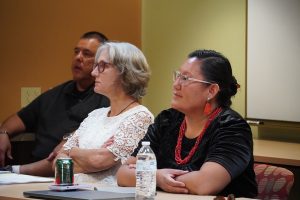
“One of the important pieces is always to remember who you are as a Native person, where you come from, and that can always help guide where you’re going,” Montoya said. “And always thinking about how you’re going to give back to your community…being able to lead with our own identities and those teachings that we have, where we come from, is just so empowering for us and for our people.”
In concluding the event, Garner conducted a Q&A. One question inquired about what inspired her to start the podcast.
“I couldn’t relate [to anyone] on my experiences of growing up as Indigenous and the other with anybody,” Garner said. “It would have been nice to hear that from other people. It would have been nice to hear stories. So we decided, why don’t we do it?”
Garner also shared advice for other Indigenous women who may feel “other” in their communities. Garner advised that the best way to be seen is to share your story in any way, even if it’s just in a school assignment.
“Any chance you get and every class you get I would say share your story,” Garner said. “Say it, voice it…Finding those culturally safe spaces is really helpful. Through AIP too, you can find those spaces.”
Those interested can find more about “Haffbreedz Podcast” through the Garner’s website.