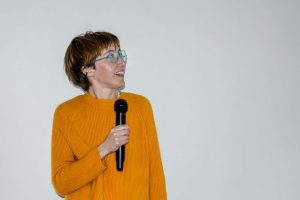
The NMSU Department of Art held a Visiting Artist Lecture, where artist Ash Eliza Williams shared the stories and inspirations behind their work on Nov. 18.
Williams is a painter and sculptor known for their dreamy, otherworldly art. Their art has been exhibited in the Denver Botanic Gardens, the University of Colorado Art Museum, the Hersbruck Museum in Germany, the New York Hall of Science, and more.
Williams’ work often delves into expressing different forms of communication through art: from pollination to bioluminescence, the language of darkness.
“I like kind of thinking about expansive ideas of communication,” Williams said. “What is communication? What is language? Is appreciating a rock a kind of communication?”
In fact, many of Williams pieces do include rocks and environment: how rocks interact with landscape, how lightning bugs communicate through blinking, and how lichens interact with chemicals, just to name a few. Williams attributes their fascination with communication to their own experiences as a child.
“I had a really hard time communicating as a kid, and I’m just interested in ways of communication that are different,” Williams said. “Bioluminescence, chemical signaling, color flashing. I think it’s all really beautiful, and thinking about like, ‘what if humans could do that?’”
Williams’ questioning has gone beyond communication, they’ve also done works on the lives of animals, with an emphasis on life from their point of view.
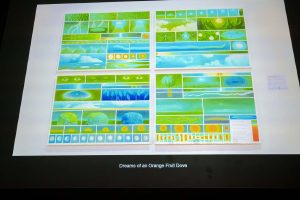
“What do creatures dream about, and what does a specific creature dream about?” Williams said. “…would this fruit dove have nightmares? What would the nightmares be? You know? What does time feel like to a little bird? What does it feel like to be covered with feathers, and to be so small?”
Williams shared that they find a lot of their inspiration from being around scientists and friends. They described how they gained inspiration for their pieces on the language of darkness after spending time at Shoals Marine Lab (SML) in Appledore Island, Maine, and McDonald Observatory in Fort Davis, Texas. their pieces on pollination and poison after a hike in Colorado, and ongoing desert-inspired pieces during their residency in Roswell, New Mexico.
They also described how simple conversations and experiences with friends have lent inspiration for their works as well.
“I think it comes from curiosity, asking people questions,” Williams said. “…a lot of this comes from simple things, you know, wanting to go on a walk with a friend and realizing they have an interesting life experience or specific interest, and then they might introduce me to someone else.”
For artists searching for similar experiences, Williams suggested to just ask.
“You can also email people,” Williams said. “I did that kind of earlier on when I was graduating. If I had a question about a butterfly, I might kind of look up a scientist on that and ask them a question. And scientists just are really receptive to questions. Everyone kind of wants to talk about what they’re curious about, so I guess lean into that.”
Williams also included advice for artists to keep a sketchbook. They explained that the process of intuitively creating art is just as important as the research aspect.
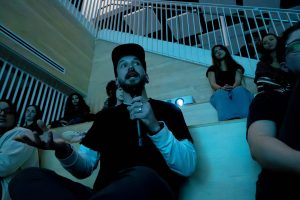
“Whenever I wake up I go straight to my desk and work; working my sketchbook with gouache, without thinking, kind of straight from dreams,” Williams said. “You know, there’s a lot of research involved in my work, but there’s also a lot of really, kind of, intuitive playing. And, you know, I filled so many sketchbooks with ideas, and I highly recommend a sketchbook practice if you don’t have one.”
During their time in Roswell, Williams shared that they’ve gained new experiences and perspectives in the desert, especially with seeing the multitude of insects.
They included that their next works will focus on the understanding of insects and how art allows them to further their knowledge and relive experiences.
“That’s one of the wonderful things about being an artist,” Williams said. “I think it allows us to relive memories, and kind of spend time with those memories.”