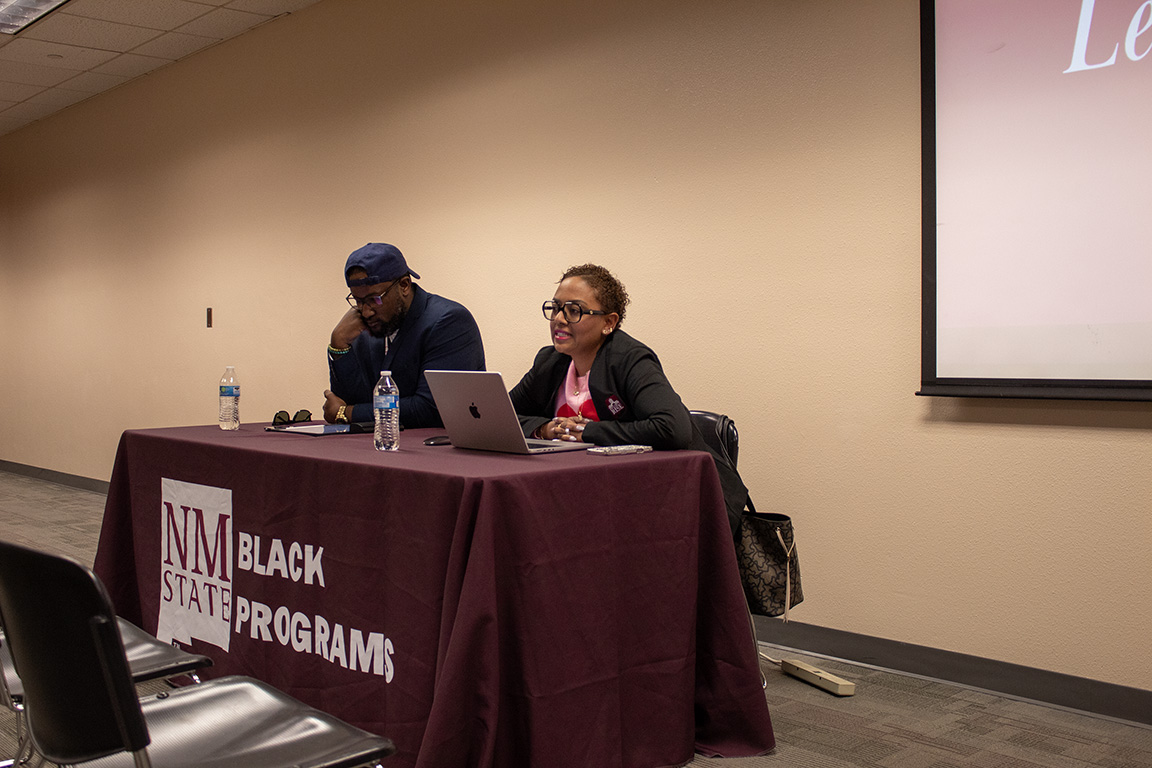
New Mexico State University’s Black Programs held a panel of experts who shared their real-world insights on building a professional footprint in collaboration with Student Involvement & Leadership programs on Feb. 11.
The panel consisted of leaders from across NMSU colleges. The panel discussion focused on the leadership philosophies and experiences of Black and Brown faculty members.
Monique Matute-Chavirria, an Assistant Professor at College of Health, Education, and Social Transformation, talked about her approach to leadership, focusing on self-advocacy and the importance of speaking up for others.
“I’m always reminded that oftentimes, I’m the only person you know, a black woman at the table, oftentimes, and I have to think about that position that I have and that I’m there for a purpose,” Matute-Chavirra said. “So I always prepare myself. I go there with intention, and then always remember, you know, that I need to speak up for others who look like me”
Sadiq Shabazz, professor of sales and marketing, shared his journey from youth pastor to leader, emphasizing the importance of self-leadership and resilience.
“When you make that choice as a black man, as a black woman, you make it a choice that is dangerous, as powerful, as beautiful and as inspiring to me, the legacy that I want to leave is that the people I interact with through my teaching, through my ministry, my teaching, through my ministry, through my research, is that young black men and women have the courage, the understanding and the inspiration to shoot for that excellence because it is a choice,” Shabazz said.
Shabazz also shared his story on how the death of an African American man named George Floyd, who was murdered by a white police officer in Minneapolis, Minnesota impacted him.
“Something shifted, something changed,” Shabazz said. “And what I’ve grown to appreciate just in the last five years, six years, is that for black people, black excellence, you add that black piece to it means something totally different, something about overcoming something tied to the roots of how we were brought to this country, without the willingness, without a desire, to be here, fighting against all of the odds to make something good, something wonderful.”
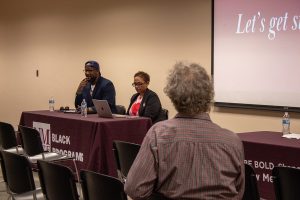
The panelists also discussed the importance of mentorship, building authentic relationships, and the need for high-quality work and personal values in leadership roles. Eric House, Associate Professor of Critical Composition and Writing Studies in the Department of English emphasized the importance of building relationships and how, if he were to go back and talk to his younger self, he would tell himself to find a mentor.
“ I just didn’t understand the necessity of that relationship. And so as I reflect on my journey, that’s one thing that I would ultimately say is finding mentors who already value the humanity in me without having to justify that through a performance or by talking a certain address in a certain way,” House said.
Meanwhile, Monique Matu Shabaria, Assistant Professor of Special Education in the College of Education noted difficulty finding mentors, especially Black women mentors in leadership.
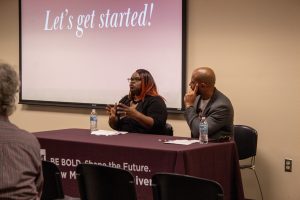
“As the only Afro-Latina student in the PhD program, [and] only black student in the program. I dealt with a lot of racism from my peers and stuff. So I could go into her office and look like, just talk really with her, and so it was life-changing,” Shabaria said.
The panel ended with the audience being able to get one-on-one conversations with the panelists. Not only did it bring awareness, highlighting the challenges faced by black and brown faculty in academic and advancement aspects, but it also emphasizes the importance of collaboration and learning from faculty experiences.