New Mexico State University’s Students for Justice in Palestine (SJP) held a screening for the film “All That’s Left of You,” a moving film following a Palestinian teenager as he and his family suffer through violence and Israeli occupation inflicted on their community.
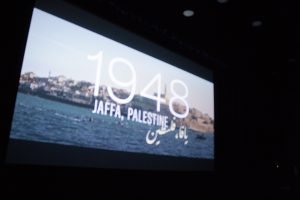
The director, Charien Dabis, brings us on a journey across multiple generations and around 70 years. The movie starts with the Nakba, the Israeli takeover and displacement of Palestinians in 1948, and brings viewers to the near-present Israeli occupation in 2022.
Salim, played by Salem Bakri, and his wife Hanan, played by Dabis, began their journey on their home and tangerine farm in Jaffa (present-day Tel Aviv). Upon the arrival of Israeli forces, the family was pushed to move to a smaller home in the West Bank of Palestine.
After being forced to move, the family learned how to navigate their new circumstances.
Despite the move, Salim and his son Noor, played by Sanad Alkabareti, eventually have a run-in with Israeli militants that leave the young boy shaken.
After the interaction, Noor lashed out against his father for giving in to the demands of the militants – a necessary but disappointing choice Salim was forced to make.
Dabis works wonderfully to convey the heartbreak of each family member as they process the desperate act – one that Salim did to save his son from harm, which becomes a major push for Noor’s passion for freedom from Israel. The acting prowess of our main characters stands out here, powerfully conveying deep emotions during tension-filled silences and uncomfortable interactions between family members.
Later, a teenage Noor, played by Muhammed Abed Elrahman, suffers a major moment of violence at a protest that shakes his family and stops the film in its tracks. The rest of the movie holds the audience with bated breath as Salim and Hanan make a difficult decision.
Throughout the film, emotions are kept high as viewers get a more intimate view on the lives of Palestinians. The dialogue between the family specifically is heart wrenching from beginning to end – with an ending scene between Hanan and Salim, with the latter reading a poem to Hanan that ties back beautifully to the beginning.
Despite the film being based in the current state of Isreal and the Gaza Strip, the film itself could not be filmed there due to the Israel-Hamas war. Instead, the movie was filmed in areas of Cyprus, Greece, and Jordan. Regardless, the film still provides beautiful and believable depictions of Palestine, from architecture to fashion.
The color and space used throughout the film stand out and help tell the story. Dreary, muted tones with bright pops of color on clothes symbolize resilience – that despite the war unfolding around them, they manage not to fall into the bleakness of their surroundings.
Scenes with extra space, showing main characters sticking out against a minimal background bring a very isolated feel; a visual story on its own on the feelings of isolation displaced families can experience
Ultimately, “All That’s Left of You” offers a lot for audiences to take in and consider – especially what you do to help the real people going through similar situations.
Dabis’ ending – Salim and Hanan visiting their old property in what is now Tel Aviv – doesn’t provide a complete feeling of closure for the audience, because the real-life situation and struggles of Palestinians are ongoing. Dabis delivers a raw, harrowing film – a call-to-action amidst a heartbreaking reality.