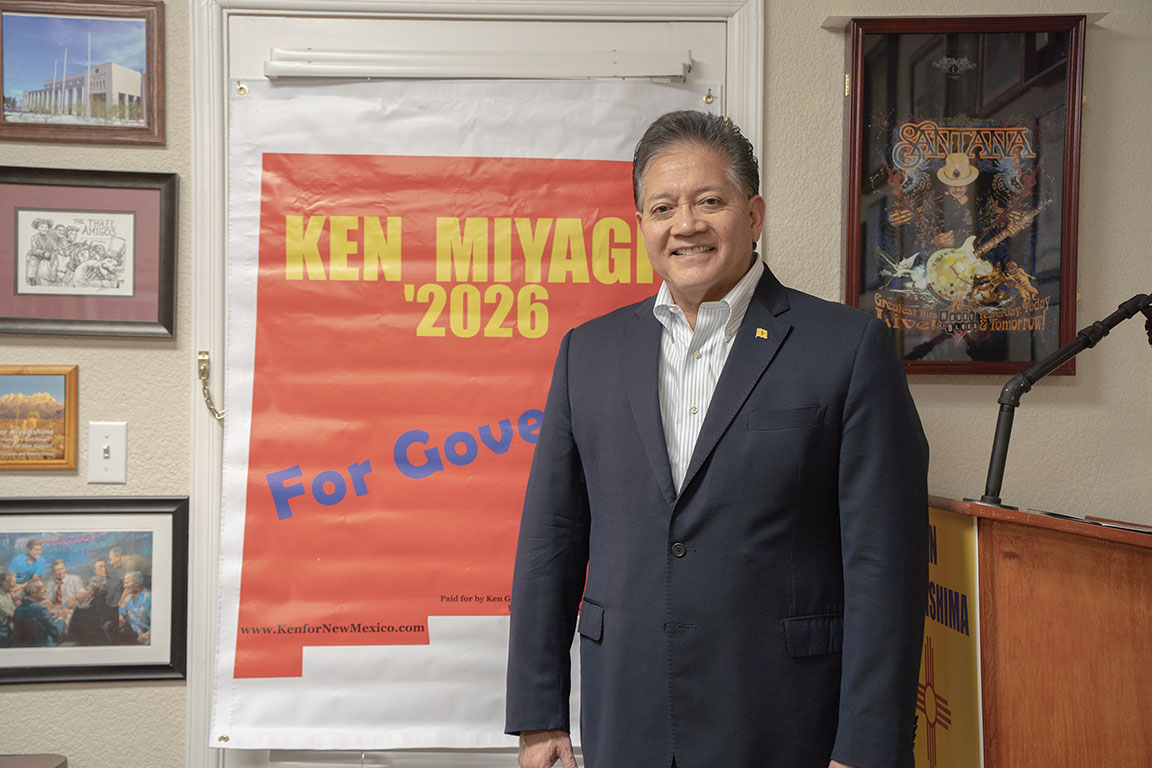
On Feb. 1, former Las Cruces Mayor Ken Miyagishima announced that despite receiving enough signatures to run in the Democratic primary, he would be running as an independent candidate in the New Mexico gubernatorial race for the General Election on Nov. 3. With political tensions rising nationally, Miyagishima said he wanted to unite Democrats, Republicans, and Independents around issues impacting New Mexicans.
“The discussion is usually just all one side, either one side or the other,” Miyagishima said. “And it all seems to be focused on Washington and not New Mexico and I thought to myself, there’s good parts on both parties, good stuff, and in New Mexico, it’s in such a dire state, I can’t govern with just one set of rules. I need to be able to be flexible, and I only have one shot. And that one shot is, you know, to be able to get my audience to hear what I have to propose.”
His campaign policies include ending medical malpractice reform, lowering crime rates, improving affordable housing, and reducing homelessness. He described something he called the “Young Adult Bill of Rights,” which is his plan to improve the lives of young people by making housing, education, mental health resources, jobs, and transportation more accessible and lowering the cost of living. Miyagishima said his experience teaching business classes at NMSU gave him a deeper understanding of what young adults in New Mexico need.
“I had a lot of them [students] on my mind, and I hope it resonates with them, because they’re our future,” Miyagishima said. “I mean, really, they are, they’re graduating, they’re going to be going out into the world, they’re going to be doing things, and they have to have a place to live. I don’t want them to be saddled with a whole lot of debt. And if they do have debt, I want them to be able to pay it off at a very modest interest rate and at the same time, maybe help the state. So that it’s beneficial to both.”
Miyagishima said he hopes to improve infrastructure on New Mexico’s reservations and include representatives from the Navajo and Pueblo tribes in his staff. As someone with indigenous heritage himself, Miyagishima expressed frustration that lawmakers haven’t included tribal leadership in conversations before.
“They’ve been forgotten,” Miyagishima said. “And that’s not right. Under my administration, they’re going to have a seat at the table. They may have two seats. They may actually have more representation than any other group. And you know, that’s okay, because for the longest time, they’ve been ignored.”
On the topic of immigration, Miyagishima said he would want to allow immigrants without felonies to continue living and working in the U.S. and ensure no one is “cutting in line” to get citizenship before others who may have waited longer. Considering recent news about Immigration and Customs Enforcement operations, Miyagishima said he would protect New Mexicans’ rights while still following federal laws.
“One of the things that we have to recognize is the federal government, they have what they call a Supremacy Clause,” Miyagishima said. “. . .But that doesn’t mean that I can’t have our state police and our military police that are in the National Guard be observing and assisting and watching to make sure they’re not violating our citizens rights.”
By running as an independent candidate, Miyagishima bypasses the partisan primaries and will run in the General Election, Nov. 3. The Democratic and Republican primary races will take place on June 2.