Read the Spanish translation of this article.
While political divisions continue to shape conversations around the country, the College Republicans at NMSU (CR-NMSU) serves as a community for conservative students seeking connection, political engagement, and open conversation.
At their meetings, members can expect to find information on voter education as well as education on the Republican Party. In the past, the club also hosted meet-and-greets with various New Mexico republicans such as Greg Cunningham and former U.S. Rep. Yvette Herrell, as well as conduct community service.
CR-NMSU has recently re-emerged from a two-year-long hiatus, similarly to the NMSU College Democrats. In the club, members have found a sense of community along with a place to fight for their beliefs. A fire lit by conservative activist Charlie Kirk’s death.
“I’m a very non-confrontational person…but I do stand firm with my beliefs,” Vice President of CR-NMSU Madelynn Dunivan said. “And so when I saw what happened with Charlie Kirk, I was like, ‘Okay, I am just one person out of this whole world who could possibly make a difference with just a small community, which will then make a larger impact to the nation, etc.’”
However, members of CR-NMSU say being conservative, on what they feel presents as a left-leaning campus, comes with challenges.
“I think that it’s certainly the case that conservative students on NMSU’s campus are the silent majority,” CR-NMSU President Jonah Arzapalo said. “When I was first trying to build this community…I had a lot of students express interest, especially at the DACC campuses. And so, it’s still a goal of mine to figure out how to bring them out of their shell…and realize that it is possible to engage in conversation, and it is possible to have opposing beliefs and still be civil with each other.”
Some of these struggles, they say, include a feeling of being silenced along with facing various accusations and misunderstandings.
Though the club differs from NMSU’s Turning Point USA and Students for Life, the clubs do collaborate, host, and attend events together. At their most recent one, Arzapalo said members received personal attacks, leaving no chance for debate, and even an email from the NMSU Graduate Workers Union.
“They sent out an email before the event, and they said… ‘It’s likely that some of these demonstrators intend on escalating and potentially causing harm to our workers,’” Arzapalo said. “And so, before the event happens to make a claim like that, to say that we’re going to harm students on campus, that’s incredibly dangerous and harmful.”
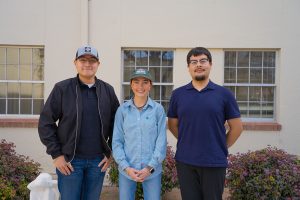
Along with the email, members say they have heard misconceptions about the club at and outside of the events.
“One of the biggest [misconceptions] that I have encountered is that we’re a group of racists on campus,” CR-NMSU Secretary Nicholas Hernandez said. “I come from a Hispanic family, and this is the only place in which I have not been labeled as something that I’m not. People’s character is what matters here in CR-NMSU, and I was finally able to be known for that rather than, ‘Oh, what race are you? Are you some kind of traitor? Are you betraying someone or some part of your family?’”
Members say that accusations of racism go hand-in-hand with homophobia. A sentiment that the club has never expressed.
“Another one that I hear a lot is that we’re homophobic,” Hernandez said. “Nobody that I know in CR-NMSU has ever said or done anything to attack someone’s gender or someone’s sexuality. I think these are words that go around very often to get an emotional reaction out of people, especially here on this campus.”
Dunivan added that students often form opinions about the club without attending meetings or engaging directly with the members, showing that many assumptions stem from broader political tensions rather than firsthand experiences with the club itself.
“I think a huge issue is that they are just misconceptions,” Dunivan said. “Nobody goes and sits down in the meetings. Nobody has the initiative to go to the meetings and realize that it’s just a bunch of college students and graduate students wanting to learn.”
Arzapalo said that while political disagreements are inevitable, the club draws a distinction between debating ideas and judging individuals.
“We can all have disagreements, but we don’t judge people on the basis of they, themselves, as a person,” Arzapalo said. “We think that every person has value as a human being. If you get down to that level, which is dehumanization, that’s no way to begin any sort of meaningful or worthwhile change.”
He added that the organization aims to create space for discussion rather than division.
“CR-NMSU is always dedicated to welcoming people of like-minded views and opposing views, to at least find common ground and understand where we both come from,” Arzapalo said.