(Content warning: This story contains discussion of femicide, murder, sexual violence, and rape.)
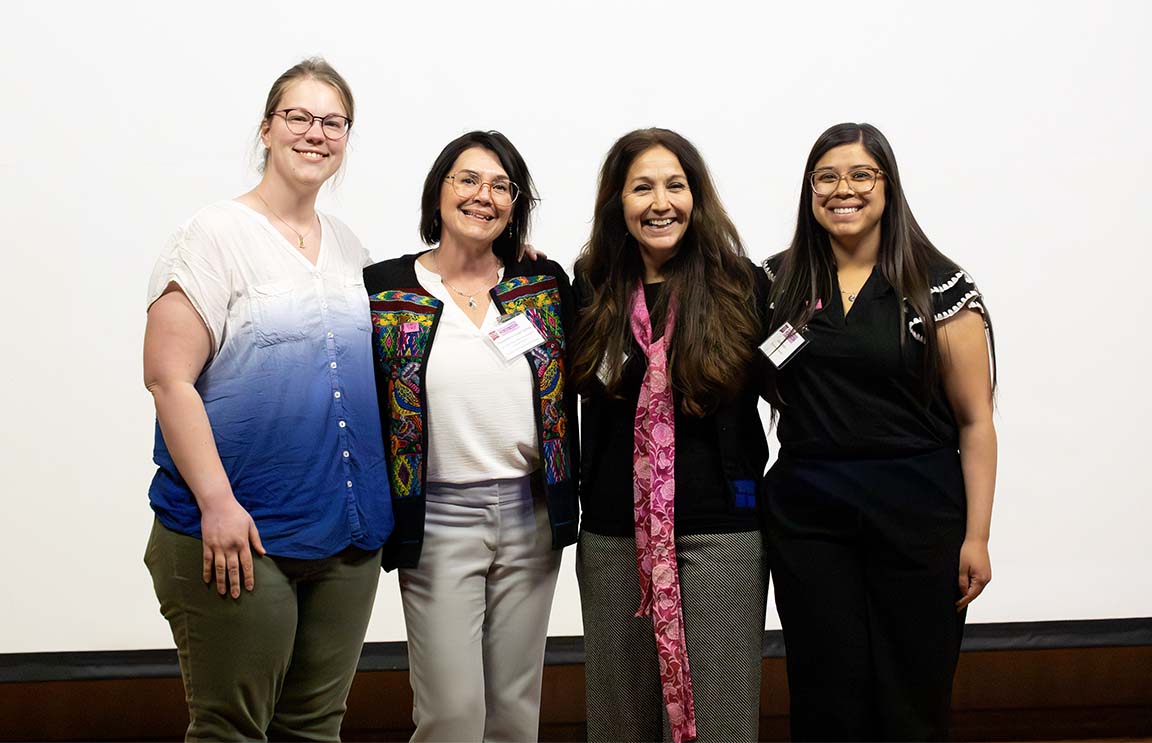
Soft sniffles and emotional breaths echoed in surround sound throughout the Corbett Center Student Union Auditorium as attendees of this year’s J. Paul Taylor Social Justice Symposium (JPTSJS), “Ni Una Más: Standing Together Against Femicide and Gender-Based Violence”, watched the documentary “The Three Deaths of Marisela Escobedo”.
On April 7, the College of Arts and Sciences and the Office of Land Grant Inclusive Mission hosted the two-day symposium, honoring the 20th anniversary of the JPTSJS from 2006 titled “Justice for Women of Juarez”.
To commemorate the original event, this year’s panelists, artwork, documentaries, and other events honored the work of femicide victims’ families, scholars, and human rights defenders over the last two decades.
Femicides and gender-based crimes refer to the killing of women, girls, and other gender identities, particularly by men, on account of their gender/identity.
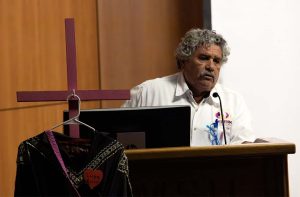
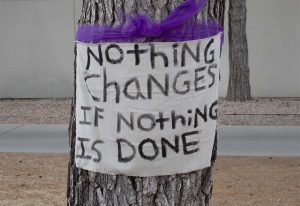
In preparation for the symposium, students spent March creating pink crosses adorned with dresses. They then decorated and hung them around campus. This reflected the cross that students in 2006 made for Justice for Women of Juarez. They also tied canvas statements to trees in protest.
Most of the event was hosted in Spanish but offered English translations with a translator speaking through headphones.
“What we’re talking about happened in Mexico, and they lived it in Spanish, so they need to express it in Spanish, not in a language that’s not familiar to them,” volunteer Jeff Longwell said.
“The Three Deaths of Marisela Escobedo”
One of many events over the two days was the showing of the documentary, The Three Deaths of Marisela Escobedo. This documentary tells the story of a mother, Marisela Escobedo, who relentlessly fought to bring her 16-year-old daughter, Rubí Marisol Frayre Escobedo’s murderer, her boyfriend Sergio Barraza, to justice.
Rubí was murdered in 2008. Despite police interaction, the investigation went nowhere until her mother stepped in, posting flyers with rewards, marching for her justice, and eventually finding Barraza herself.
Evidence shown in court and an apology from Barraza were still not enough for the court to convict him, and he was released. Escobedo did not stop her fight; she reappealed and got him convicted. But he had already left the City of Juarez.
Escobedo and family searched for him themselves. When she found him and called the police, they had let him escape. During this time, Barraza became a member of the Zetas cartel and became protected by them and the government due to cartel connections.
As she continued to protest and fight on, Escobedo was shot and killed on camera in front of the Government Palace in Chihuahua City.
On the day of Escobedo’s funeral, her business and brother-in-law were set on fire.
The documentary highlights the systematic failures of the Mexican government in addressing violence against women, while also showing the impact of Escobedo’s fight, and its lasting effects and meaning in the current world, through the lens of the Escobedo family.
Connections to NMSU
While what was discussed at the event happened mostly in Mexico, New Mexico State University is only about 45 miles from the border.
Cynthia Bejarano, Regents Professor and the College of Arts and Sciences Stan Fulton Endowed Chair and the Principal Investigator of the College Assistance Migrant Program, was the main organizer of the event.
Bejarano said this event was an important reminder of how close and intense femicide and gender-based crimes are.
“One of the greatest human rights atrocities in contemporary history happened just forty miles down the road over several, several years,” Bejarano said. “There are some deep-seated connections across both sides of the border.”
Some of those deep-seated connections are planted at NMSU. Next to Garcia Hall is a tree with a plaque dedicated to Carly Martinez, an NMSU student who lived in Garcia Hall. Martinez was a victim of femicide in 1998.
As described on a podcast called True Crime in the 50s, Carly Martinez’s roommate called 911 to report her disappearance after not seeing her in over a day. Martinez had gone on a date with Jesse Avalos and was joined by his friend, Jason Desnoyer, later in the date. That night, she disappeared, and it took the police over two months to find her body. Once her body was found, it was determined that she had been raped and brutally murdered.
Later, in 2003, Katie Sepich, an NMSU graduate student, was found by a couple practicing shooting in a desert outside Las Cruces. They found Sepich deceased, face down and partially clothed, with burns. A few hours later, her friend called 911 to report Sepich missing. The friend told police she left a house party on foot without her car, keys, and phone, after she and her boyfriend got into an argument.
It took about three years to find Sepich’s killer, Gabriel Avila, who had also broken into the on-campus apartment of two other female NMSU students but was let out on bond.
The Finale
To close the symposium, a reception was held at Corbett Center Outdoor Stage, where awards were given, poetry was read, music was sung, and candles were lit as a vigil for victims.
The symposium was filled with tears and had lasting impacts across communities.
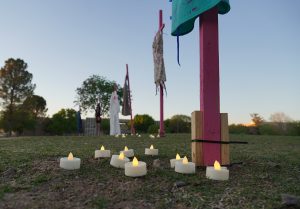
“More than anything, it’s been kind of grounding, just to learn a lot more about, I mean, just be conscious of issues that, as a man, you’re not necessarily as conscious of because they don’t impact you in the same way,” attendee and intern for the Office of Land Grant Inclusive Mission, Trey Rosales, said.
As part of the vigil, all attendees, panelists, organizers, and volunteers joined together to sing Ni Una Más, a song written by Lucha Castro, co-founder of Justicia para Nuestras Hijas and founder of Centro de Derechos Humanos de las Mujeres.
“Ni una más, ni una más, ellas gritan ni una más, ellas gritan ni una más,” the crowd sang, holding candles and soaking in the last bits of the symposium.Taking with them new information, understanding, and respect.