After seven years of negotiations, graduate workers who work 20 hours a week will now receive a scholarship covering their full-time academic requirements.
Depending on major and degree type, many NMSU graduate students are required to be either teacher assistants (TA), research assistants (RA), or graduate assistants (GA) in addition to nine credit hours of coursework and a minimum 3.0 GPA to be classified as full-time students.
Caedmon Ragland, the president of the Graduate Workers United, explained that this leaves no time for graduate workers to get additional jobs, forcing them to live off what their graduate worker’s salary can provide.
Even though the university pays them for their work, graduate workers were still paying for their coursework, often using money from their university salary.
“We are no longer paying to work here,” Ragland said.
Required to commit the majority of their time to NMSU, they lack free time. Graduate worker Yvette Michalak said the lack of time creates a lack of financial freedom, causing the quality of life for graduate students to be low.
“It’s [the scholarship] a big weight lifted off our shoulders,” Michalak said. “Now I’m able to, instead of buying a cup of noodles, maybe I could have some chicken or a nice salad, some fruit.”
Ragland said it’s difficult for graduate workers to provide for themselves. It is also often assumed that graduate workers and students only need to take care of themselves.
“This has all, so far, been assuming that you are a single individual with no dependents,” Ragland said. “If you happen to be a mother with kids, or a father with kids, or any other type of parent. If you have a spouse or a parent you’re helping to care for, it gets even harder.”
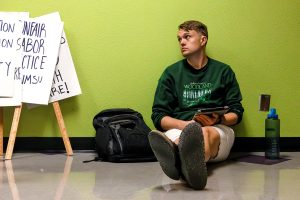
While the win has relieved some pressure on graduate workers, the fight to get here was long and hard, Ragland said. And there’s still more to fight for.
The graduate workers’ union was started over seven years ago by Emmy Mara. The purpose of the union was to give graduate workers a voice about their work conditions, better pay, and a fairer workplace.
Because of the financial strains, Graduate Workers United at NMSU is supported by United Electrical, Radio, and Machine Workers of America (UE). UE provides legal and financial assistance along with other supplies to help the graduate Workers Union succeed.
Despite receiving legal assistance from the UE, Ragland explained how difficult it can be to negotiate with NMSU because they have stronger resources like lawyers, time, and money.
Ragland said during negotiation, graduate workers, with already gam packed schedules, prepare a proposal. They then discuss the proposal and negotiate with NSMU’s general council, high-level administrators, and high-paid lawyers to reach an agreement.
Responses from NMSU’s team can also make negotiations difficult, Ragland said.
“You’re getting responses that are dismissive of the struggles that graduate workers face,” Ragland said. “And this continues on and on, and you make incremental progress. That’s demoralizing, honestly.”
In regard to graduate workers, NMSU President Valerio Ferme sent out an Email Feb. 18 with this statement:
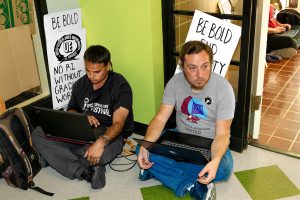
During the summer, I made a promise to NM Rep. Patricia Roybal Caballero to increase our support for graduate student workers to cover 9 credits per semester. Though we had just completed and closed the collective bargaining agreement, the leadership team felt there was room to improve our support of graduate students, both as a way to attract more talent and as a way to give students the opportunity to stay on track with their graduation requirements.
Ragland said the University offered a Memorandum of Understanding (MOU) to raise the scholarship from six to nine credits. An MOU agreement is a formal, yet non-binding agreement that indicates a commitment to work together. The union had to push to ensure the language in the document guaranteed they secured nine credit hours covered by scholarship regardless of factors like in-state tuition.
“We’ve been telling the University to eat its vegetables for over seven years, and the University now wants to take a victory lap for finally listening,” Ragland said.
Ragland said there are still issues with the current contract. The contract said that NMSU must create a list of eligible students for the scholarship, and it will be given on or around mid-semester.
Ragland explained this means graduate workers won’t receive their funds until much later in the semester. This forces them to find a way to pay tuition at the beginning of every semester by taking out loans or enrolling in a payment plan, which has added fees.
“We have full tuition coverage, which is nice,” Ragland said. “But how do we make our way from the start of the semester to when we actually get those funds?
Despite the difficulties Graduate Workers United has faced, it has also created a community of graduate workers that otherwise may not exist.
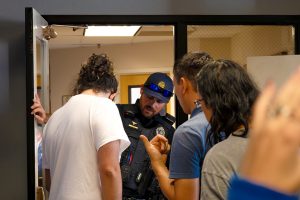
“It is really inspiring to see all of these people come together and utilize their individual skills to fight for this good together,” Ragland said. “There are people that I would never have been able to meet if I were not part of the Union.”
Graduate Workers United’s community isn’t just those still attending NMSU; it stretches over the past seven years.
Ragland reached out to past union members and leaders to inform them of their recent success.
“It took longer than we would’ve liked, but we actually got there,” Matt Verakian, a member of the Unions first contract bargaining team, said to Ragland during a phone call. “Progress is incremental. Just because it’s gradual doesn’t mean it’s not worth it, I’m just really happy for all and the graduate workers.”
Michalak said that the work others have done to help get the union to this place has been motivating.
“Their work and time is priceless really,” Michalak said. “For somebody to work on something that they’re not even going to get the benefits out of, it just shows how much of a team player they are and how united they are with everyone.”
While Graduate Workers United is celebrating its achievement, Ragland said there is still more work to be done, and the group will continue to fight for a better workplace for graduate workers.