In the cliffsides and dried-up arroyos of Northwestern New Mexico, deposits of sandstone and mudstone contain traces of a primordial scene. What are currently fossils were once the bones of living, breathing, animals. While the landscape today is the arid Colorado Plateau, 66 million years ago, it was a lush, subtropical upland that teemed with rivers.
Those same cliffsides and arroyos also contain the boundary between the Cretaceous and Paleogene periods, the mark of the Chicxulub asteroid impact. Although experts in the paleontological field have originally argued that non-avian dinosaurs were already in decline by the time of their extinction, the field work of some is beginning to uncover that, in many regions, dinosaurs had in fact reached the peak of their diversity right up until the impact.
New Mexico State University assistant professor Andrew Flynn was a part of an international team that studied the last dinosaurs to have walked the globe. Their Oct. 23 paper, “Late-surviving New Mexican dinosaurs illuminate high end-Cretaceous diversity and provinciality,” details the geological field work they had conducted in New Mexico.
The Montana scene of Steven Spielberg’s “Jurassic Park” (1993), along with other mainstream depictions of dinosaurs, has caused some in the public to picture the discipline of paleontology in a certain way. However, Flynn said that the labor of a paleontologist is more nuanced than dusting sand with a brush.
“People have this image of people out in the desert, digging big holes, and finding dinosaurs,” Flynn said. “And that’s not how it is; usually the bones are on the surface. And so, you only dig the holes if you really want to dig one out. But we’re not just randomly digging holes until we find dinosaurs at the bottom.”
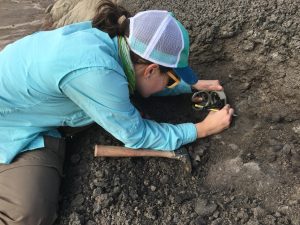
Flynn explained that their field work took place at the Naashoibito Member, or subdivision, of the Ojo Alamo Formation in San Juan County, New Mexico. The rock formation is located in the Bisti/De-Na-Zin Wilderness Area, near the city of Farmington, and has already been studied in past years.
“This was a big collaboration with people all over the world, and from all over the United States: Oklahoma, Nebraska, and Texas, as well as some from the UK and Spain,” Flynn said. “This all started in 2011 before I even started grad school, and it was part of my dissertation at Baylor.”
The deposits of sediment that Flynn’s team studied were within the final several hundred-thousand years of the Cretaceous, the third period of the Mesozoic era. This makes the dinosaurs within the deposit some of the geologically latest of their lineage.
“We did some work using a couple of different methods and determined that these rocks are not just from the end of the Cretaceous,” Flynn said. “They are some of the very last dinosaurs, right up until the mass extinction event. They are within a couple 100,000 years of the boundary, which, in human terms, is a long time. But, geologically speaking, that is incredibly close. They’re the same age as the famous dinosaurs from the Hell Creek Formation in Montana and North Dakota, including T-Rex and Triceratops.”
The Ojo Alamo Formation was the habitat to several species either native to New Mexico or present across the entire Western U.S. It includes remains of the dromaeosaurid (or “raptor”) Dineobellator notohesperus, the ceratopsian Ojoceratops fowleri, and the gigantic sauropod Alamosaurus sanjuanensis. The formation was even once home to the renowned Tyrannosaurus rex.
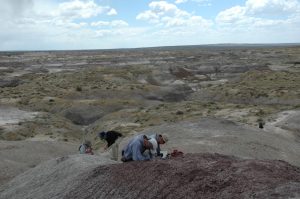
“New Mexico has an incredibly rich fossil record of life,” Flynn said. “In Las Cruces, we have exposed rocks that record fossils from 500 million years ago all the way up until the last Ice Age, 12,000 years ago. There are dinosaur fossils from Truth or Consequences, which are not that far away from here. New Mexico has a very understudied record. And it’s a beautiful place.”
Flynn said paleontology should be important to New Mexicans. Not only should it be a source of pride, he said, but also a way to examine how sudden climatic changes, similar to the ones currently caused by human activity, affect life on our planet and the environments it inhabits.
“On the sociological side, it’s our heritage,” Flynn explained. “These are things that New Mexico should be proud of. It is also a great way to get people interested in STEM sciences in general; dinosaurs are a fantastic way to do that. And then all the climate stuff can really help inform our future. Our modern climate is changing, and this [the end-Cretaceous impact] is a time where we know there was climate change happening. So, what happens afterwards, and what paleontology uncovers from it in general can really help inform decision making in the future.”