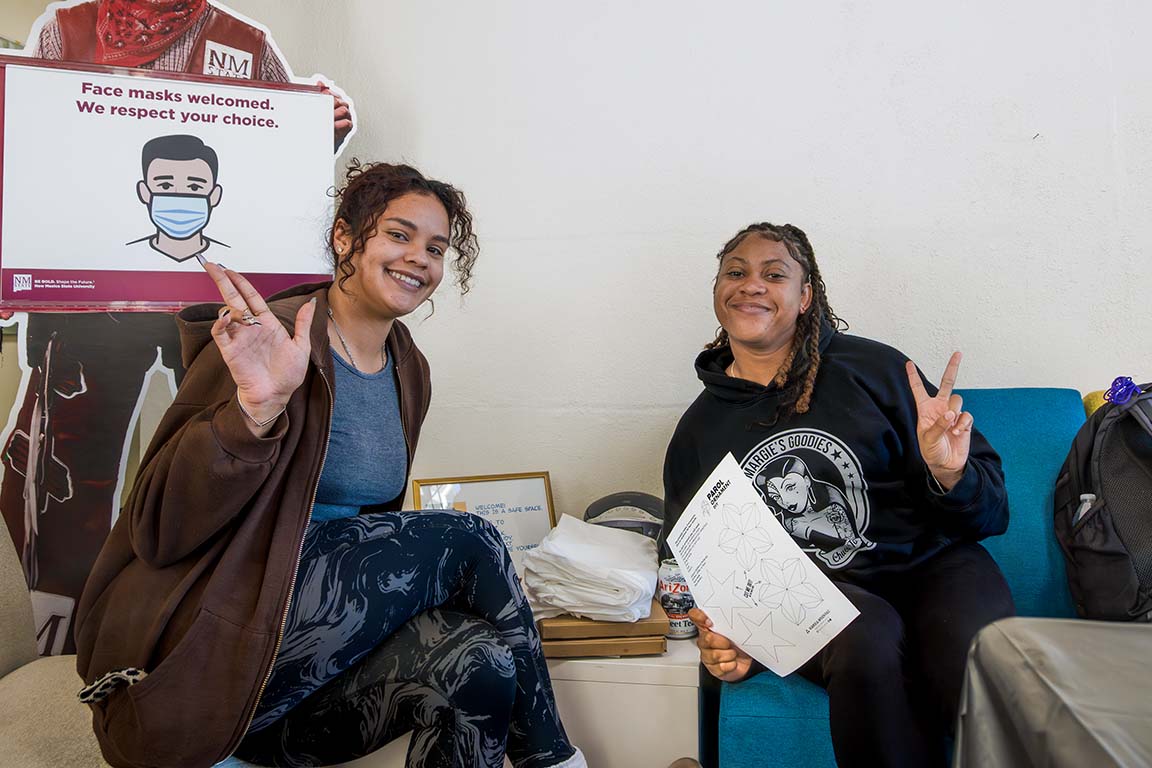
The smell of food wafted through Garcia Center as students and staff sat at tables eating and making parols, a star-shaped lantern or ornament traditional to Simbang Gabi Dec 2.
On Dec. 2 the Asian Pacific Islander (API) Program held an event to share a Filipino tradition and create a place for students to experience their own culture or learn about a new one.
According to Sinaunang Panahon, Simbang Gabi is a Catholic Filipino Christmas tradition. Often translated to Night Mass, the tradition contains nine dawn masses that lead up to Christmas Eve.
While the holiday is traditionally a religious event, it has grown into a cultural one as well. For some students at New Mexico State University, this event holds a deep meaning.
NMSU student Hyacinth Faye Panganiban is originally from the Philippines and moved to Roswell for seventh grade.
“I think NMSU integrating something like this is really important for people that are like me, who’s wanting to find community,” Panganiban said.
For Panganiban, growing up in Roswell came with some culture shock because of the contrast from a big city to a small town.
“Whenever I went to school, I couldn’t find anyone that looked like me,” Panganiban said. “There were only a select few people that looked like me that I could relate to.”
Panganiban said there is a small Filipino community in Roswell, but she didn’t think there would be a community at NMSU and is happy to have found one.
Tristan Tamez, president of a separate organization the Asian Pacific Islander (API) Aggies also attended the Simbang Gabi event.
“I’m really happy that we are celebrating Asian culture and specifically Filipino culture,” Tamez said. “It’s hard to come by that out in New Mexico.”
Tamez said he didn’t grow up participating in Simbang Gabi and described his family as very westernized. Despite the various cultural groups and events in the Philippines, Tamez expressed how making parols is a big Christmas tradition.
“The Philippines is a very Catholic country, so Christmas is a very important time of year,” Tamez said. “I’m more along the lines of organizing and community building myself.”
When Tamez and his colleague began looking for an Asian Pacific Islander community on campus they were told to visit the International Student Scholar Services. Tamez said the resource was a dead end for them.
“None of us were international students, but we’re still Asian,” Tamez said. “That is something that we kind of as Asian Americans struggle with is the tug between being Asian, being American, and trying to find an area to balance.”
Tamez said that Asian Americans are often seen as the perpetual foreigner.
“No matter how hard we assimilate, we’re always seen as other[ed],” Tamez said. “That’s one of the biggest reasons why we established Asian Pacific Islander Aggies.”

Having the program established and funded brought the Asian Pacific Islander Aggies a voice on campus and gave them the ability to create a community and presence, Tamez said.
“We’re more than just caricatures; we’re more than just others. We are people with rich and diverse histories,” he said.
Several students sat together at tables, laughing and conversing while making their parols. Natalia Sierra, Emmanuel Padilla, and Miriam Silva were among the crowd.
Sierra and Silva both work for the sister division of the API Program, the Office of Land Grant Inclusive Mission and have attended other API Program events.
“They’re [the events] always great, the foods always spectacular,” Sierra said. “There’s always something fun to do so I try to go to every single one of these.”
Padilla is a first-time API program event attendee. He found the event on Crimson Connection and was all for free food, a fun activity, and making friends.
“It’s nice to see that people like me and people outside of the culture can celebrate these events,” Tamez said. “My biggest hope is that we can continue to move forward with this and that we keep our diversity programs up and running.”